Why the Order You Pack a Cooler Decides How Cold Your Food Stays
Quick Answer: Cold sinks, so ice belongs on top and the most perishable food belongs at the bottom. Air is the enemy - every empty gap fills with warm air that has to be re-cooled every time you open the lid. Pack in layers: a base of ice or frozen blocks, dense frozen items next, perishables in the cold middle, and a full top layer of ice covering everything. Two rules do most of the work: pre-chill the cooler the night before, and pack it completely full.
A well-packed cooler holds safe temperatures for hours longer than a badly packed one with the same amount of ice.
None of this costs anything except sequence.
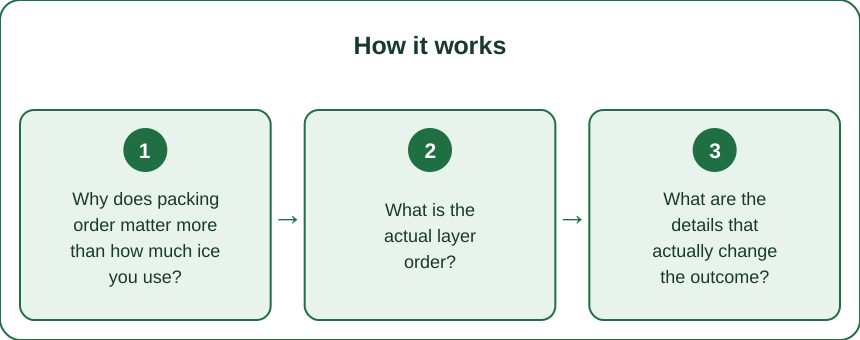
Why does packing order matter more than how much ice you use?
Because of how cold air moves and where warm air gets in.
Cold air sinks. Ice at the bottom cools the layer directly around it and very little above. Ice on top sends cold downward through the entire cooler - which is why the single most common packing mistake is dumping ice in first and stacking food on top of it.
Air is the problem, not the ice. Empty space fills with air, and air has almost no thermal mass. Every time you open the lid, all of that air is exchanged for warm air, and your ice has to cool it from scratch. A cooler packed to 100 percent capacity holds temperature dramatically longer than one packed to 60 percent, using the same ice.
The food itself is thermal mass. Chilled and frozen items help hold the temperature, which is why a full cooler of cold food outperforms a half-empty one with more ice.
And the danger zone is narrow. Food safety guidance puts the risk range between about 40°F and 140°F, with a two-hour limit at ordinary temperatures and only one hour above 90°F. A cooler that drifts above 40°F starts that clock, which is why the goal is not just cold but consistently cold.
What is the actual layer order?
Six steps, bottom to top.
1. Pre-chill the cooler. The night before, put a bag of sacrificial ice inside and close it, or leave the cooler somewhere cold. A room-temperature cooler consumes a large share of your ice just cooling its own walls - this step alone extends useful life by hours.
2. Base layer: a solid block or frozen bottles. Blocks melt far more slowly than cubes because there is less surface area. Frozen water bottles are the best budget version - they act as ice and then become cold drinks.
3. Frozen and last-to-eat items next. Anything you will not touch until the end goes low, where it is coldest and most protected from lid-opening.
4. Perishables in the middle, in sealed rigid containers. Rigid containers keep food out of meltwater - a soggy sandwich is a packing failure, not a food failure. Raw meat, if any, goes at the very bottom in a sealed container so nothing can drip onto anything.
5. First-to-eat and delicate items on top. Fruit, sandwiches, anything crushable.
6. Top layer of ice covering everything. Cubes work well here because they fill gaps. Cover the whole surface, corner to corner - this is the layer doing most of the cooling.
Then fill remaining gaps with towels, extra ice, or crumpled paper. No empty space anywhere.
What are the details that actually change the outcome?
Several, and most of them are free.
Two coolers beat one, if you have them. Drinks get opened constantly; food does not. A dedicated drinks cooler means the food cooler is opened three times instead of thirty, and lid openings are the largest source of heat gain.
Everything goes in already cold. A cooler maintains temperature; it does not create it. Room-temperature items put in a cold cooler will warm everything around them while they slowly chill. Refrigerate overnight.
Do not drain the meltwater. This is counterintuitive and well established. Ice-cold water conducts cold to food far better than air does, and draining it replaces cold water with warm air. Drain only if food is floating in it and not sealed.
Keep the cooler out of direct sun. In the shade, under a blanket, or covered with a light-colored towel. A cooler in direct sun can gain heat faster than any amount of ice can offset, and the car trunk on a warm day is the worst place of all - use the back seat.
Freeze what you can. Frozen grapes, frozen juice boxes, and frozen water bottles all double as coolant and thaw in time to eat.
And a rough ratio to plan around: two parts ice to one part contents by volume for a full day out.
5 Mistakes Everyone Makes With Picnic Coolers
1. Ice on the bottom. Covered above and worth repeating because it is nearly universal. Cold sinks; the ice belongs on top.
2. Packing it half full. Empty space is warm air waiting to happen. Fill gaps with towels if you have nothing else - a full cooler of anything beats a half-empty one.
3. Opening it to browse. Every opening exchanges the air. Know roughly where things are and take out what you need in one go. A written list taped to the lid sounds excessive and works remarkably well for a long day.
4. Draining the meltwater. The cold water is an asset. Draining it is actively harmful unless food is unsealed and floating.
5. Trusting the two-hour rule loosely. The window is two hours at normal temperatures and one hour above 90°F, and it counts total time out of refrigeration - including the drive, not just the time on the blanket. The clock started when you left the house.
Does this change for a late-summer or early-fall picnic?
Yes, in both directions, and the fall version catches people out.
Late-summer heat compresses the safety window. Above 90°F the safe window drops to one hour, and car interiors reach far higher than the outside temperature within minutes. The cooler belongs in the passenger compartment with the air conditioning, not in the trunk.
Yellowjackets peak in late summer, and they are drawn to sugar and protein. A closed cooler is your best defense - which is another argument for the two-cooler setup, since the frequently opened drinks cooler can stay well away from where you are sitting.
Then fall reverses part of the problem. In cool weather people relax about the cooler entirely - but a 65°F afternoon is still well inside the danger zone, and the two-hour rule applies exactly the same. Cool air feels like refrigeration and is not.
Fall picnics need less ice and more insulation. A smaller amount of ice lasts far longer, and the bigger risk becomes hot foods going cold rather than cold foods going warm. An insulated container with a pre-heated interior handles soup or chili well.
And the ground gets cold and damp. A cooler set directly on cool autumn ground actually stays colder - that is the one seasonal factor working in your favor. Put the blanket on an insulating layer and the cooler straight on the grass.
FAQ: Cooler Packing Questions, Answered
Block ice or cubed ice?
Both. Block ice lasts far longer and belongs at the bottom; cubes fill gaps and belong on top. Frozen water bottles are a good stand-in for blocks and become drinking water later.
How long will a well-packed cooler stay safe?
A pre-chilled, fully packed cooler kept in the shade commonly holds under 40°F for a full day, and good hard-sided coolers do much better. The variables that matter most are pre-chilling, fullness, and how often you open it - not the price of the cooler.
Do I need a thermometer?
A cheap fridge thermometer inside removes all the guesswork. Under 40°F is the target. It is the only way to know whether your packing method actually worked rather than assuming it did.
TL;DR:
- Ice on top, not on the bottom. Cold sinks, so a top layer cools the whole cooler.
- Pack it completely full. Empty space is warm air, and lid openings replace all of it.
- Pre-chill the cooler the night before and put everything in already cold.
- Do not drain the meltwater - ice-cold water conducts cold better than air.
- The two-hour window is one hour above 90°F, and it starts when you leave the house.
Pre-chill the cooler tonight before your next outing. It is the step that costs nothing and buys the most hours.
Keep Reading
This article is for general informational purposes only and is not medical advice. Always consult a qualified health professional for guidance specific to you.