Why Does Timing Decide an Autumn Picnic More Than the Food?
Quick Answer: Autumn picnics are governed by a narrow window: the ground is damp until mid-morning, the air is only comfortable from late morning to mid-afternoon, and the temperature drops sharply once the sun goes behind trees or buildings — often an hour before actual sunset. Roughly 11am to 3pm is the reliable window in most temperate regions, and getting that right matters more than anything you pack.
You brought the good bread and the proper flask.
You arrived at four, and by half past everyone wanted to go home.
This is general information, not medical advice.

Why is the autumn window so narrow?
Three constraints close in from both ends.
The ground stays wet until late morning. Autumn nights produce heavy dew, and with weaker sun and lower temperatures it takes far longer to burn off. Grass that would have been dry by nine in July can still be wet at eleven in October. A picnic mostly involves sitting on the ground, so this sets the earliest realistic start.
The air is only comfortable for a few hours. Temperature typically peaks in the early to mid afternoon and the comfortable band is much narrower than in summer. Before it, you are cold; after it, you are cold again.
The sun disappears behind things long before it sets. This is the constraint people account for least. The low autumn sun goes behind trees, hedges, and buildings while it is still well above the horizon, and the moment it does, the temperature in that spot drops sharply. A picnic can go from pleasant to over in ten minutes, and it happens well before the light does.
The ground stops giving heat back. Through summer, soil and paths absorb heat all day and release it into the evening, which is what makes late summer evenings outdoors comfortable. By October there is much less stored heat, so the drop after the sun leaves is faster and steeper.
In practice: 11am to 3pm. Late enough for the ground to dry, early enough to finish before the sun goes behind anything. Adjust for how open your spot is and how far north you are.
Does a sunny forecast change this?
It widens the comfortable middle and does not change the ends. Dew still needs to burn off, and the sun still goes behind the treeline at the same time regardless of how warm the afternoon was.
How do you pick the spot differently?
In summer you choose shade. In autumn you choose sun, and specifically sun that will still be there in an hour.
This is the single most useful autumn picnic skill, and it takes ten seconds. Look at where the sun is, look at what is to the west of your spot, and estimate whether it will still be in sunlight when you want to be eating. A beautiful spot that goes into shade twenty minutes after you settle is the most common autumn picnic mistake.
Other selection criteria that change:
Open ground beats sheltered ground for warmth, if it is calm. Trees keep sun off. In autumn that is a cost rather than a benefit.
Shelter beats sun if it is windy. Wind removes more warmth than autumn sun provides. A sunny exposed hilltop in a breeze is colder than a sheltered spot out of the sun.
South-facing slopes are noticeably warmer. With a low sun angle, a slope tilted toward the sun receives considerably more direct energy than flat ground. It is a real and usable difference.
Avoid the bottom of valleys and anywhere near water. Cold air sinks and collects in low ground, and water holds cool air above it. A hollow that was pleasantly cool in August is genuinely cold in October.
Hard surfaces beat grass. A wooden bench, a stone step, or a dry path is drier and warmer than grass. A picnic does not have to be on a blanket on a lawn.
What about picnic tables?
They solve the damp ground problem entirely, which is the biggest practical issue. Wooden tables in shade stay cold and damp, so the same sun rule applies.
What actually changes about the food
Less than people think, and in one specific direction: temperature retention matters more than freshness.
In summer the enemy is food getting too warm. In autumn it is everything going cold within twenty minutes, including things that were meant to be cold anyway.
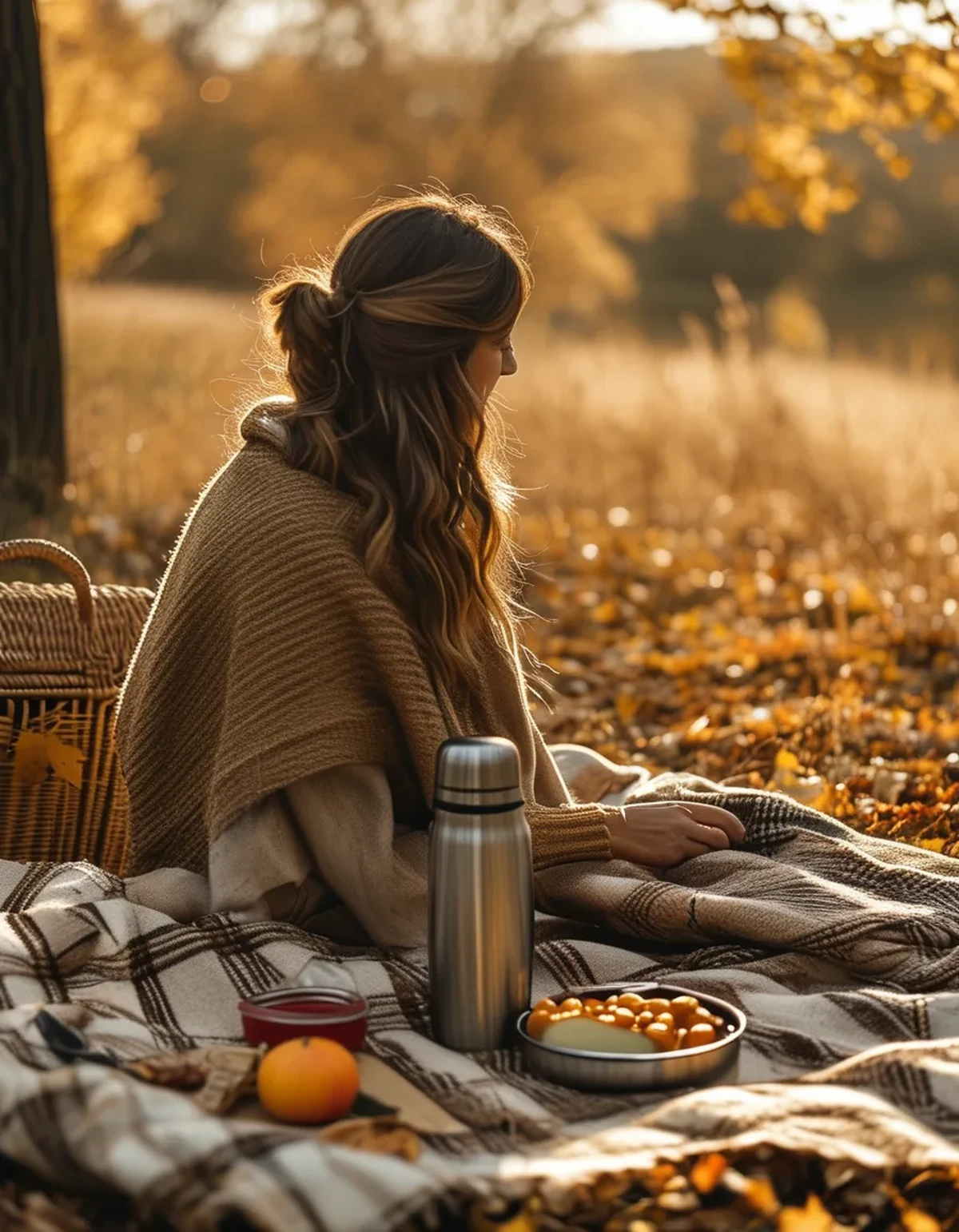
A flask earns its place. Hot drinks, or soup, transform an autumn picnic more than any food item. The warmth from the inside does more than an extra layer, and holding a warm cup addresses the hands, which get cold first.
Foods that are good at room temperature travel better than foods that need to be cold. Cheese, cured meats, bread, hard-boiled eggs, roasted vegetables, and anything pastry-based all hold up. Salads with delicate leaves and anything relying on being properly chilled are less rewarding.
Dense and substantial beats light and fresh. Cold weather increases appetite for heavier food, and a summer-style light picnic can be unsatisfying in October. This is one of the few times when adding a starchy component genuinely improves the meal.
Bring more than you think for the drinks and less for the food. People drink considerably more hot drinks than expected and eat slightly less than in summer.
Food safety still applies. Cooler autumn temperatures give more margin than summer does, and anything that should be refrigerated should still be kept cold and eaten within a reasonable window.
Should I bring something to cook on?
Where it is permitted and safe, a portable stove for hot drinks extends the window considerably. Check local rules — many parks and countryside sites restrict this, particularly after a dry spell.
What nobody tells you about autumn picnics
The ground is colder than the air, and that is what ends it. Conductive heat loss into cold ground is far more effective at chilling you than the air is. A foam mat, a folded blanket, or anything insulating underneath extends an autumn picnic by an hour or more. This is the single most underrated item.
Waterproof underneath is separate from insulating. You need both — something that stops damp coming up and something that stops heat going down. One blanket rarely does both well.
Wasps are worse in autumn than in summer, then vanish. Late-season wasps behave differently; their colonies are past their peak and they become notably more persistent around sweet food and drink. Covered cups and a bin bag for waste solve most of it. The good news is that after the first proper cold, they are gone entirely.
Everything takes longer than you plan. Autumn light makes people linger for photographs, walking to the spot takes longer on muddy ground, and packing up in the cold is slower. Building in extra time at the start rather than the end works better.
Bring a bag for wet things. Blankets, coats, and shoes all come back damper than they went out. Having somewhere to put them prevents the whole car smelling of wet wool.
The light is genuinely better. Low-angle autumn sun is the reason photographers get up early and stay out late. An autumn picnic in good light looks and feels better than a midsummer one at noon — which is most of why it is worth the extra planning.
Nobody regrets bringing an extra layer. The most reliable observation about autumn outdoor eating there is.
FAQ: Autumn Picnic Questions, Answered
What is the latest I can realistically start?
Work backwards from when the sun will go behind whatever is west of your spot, and allow at least an hour before that. In many places in October that means starting no later than two.
Is it worth going if the forecast is only around twelve degrees?
In calm sunny conditions, twelve degrees is comfortable for a couple of hours with proper insulation underneath and a hot drink. In wind or shade at the same temperature, considerably less so. Wind matters more than the number.
What is the single best item to bring?
Something insulating to sit on. It addresses the largest source of heat loss and costs almost nothing.
How do I keep hot drinks hot?
Pre-heat the flask with boiling water for a minute before filling it, and keep it closed. A pre-heated flask holds heat substantially longer than a cold one.
Are there fewer people at picnic spots in autumn?
Markedly fewer, which is one of the better arguments for going. Popular spots that are impossible in July are empty in October.
What about rain?
Autumn showers pass quickly. A large waterproof sheet that can go over people and food for ten minutes turns a cancelled picnic into an anecdote, and it weighs almost nothing.
TL;DR:
- The autumn window is roughly 11am to 3pm — after the dew has gone, before the sun goes behind the treeline.
- The sun disappears behind obstacles long before sunset, and the temperature drops sharply when it does.
- Choose a spot for where the sun will be in an hour, not where it is now; south-facing slopes and hard surfaces are warmer.
- Insulation underneath prevents more heat loss than any extra layer, and a pre-heated flask does the rest.
- Bring food that is good at room temperature and heavier than a summer picnic.
The food barely matters. Arrive at eleven with something to sit on and a flask, and the same picnic that failed at four is excellent.
This is general information, not medical advice. Follow local guidance on fires, stoves, and site rules.
Keep Reading
This article is for general informational purposes only and is not medical advice. Always consult a qualified health professional for guidance specific to you.