Why Picnic Food Safety Changes the Moment You Open the Cool Box
Quick Answer: Chilled food is safe below 5°C, and bacteria multiply fastest between about 8°C and 63°C — the range often called the danger zone. A well-packed cool box holds temperature for hours while closed, and loses a large amount of its cold air every time it is opened, because cold air is dense and pours out. General food safety guidance allows chilled food out of refrigeration for a limited period — commonly cited as up to four hours — after which it should be discarded rather than re-chilled. The practical fix is two containers: one you open constantly and one you barely open at all.
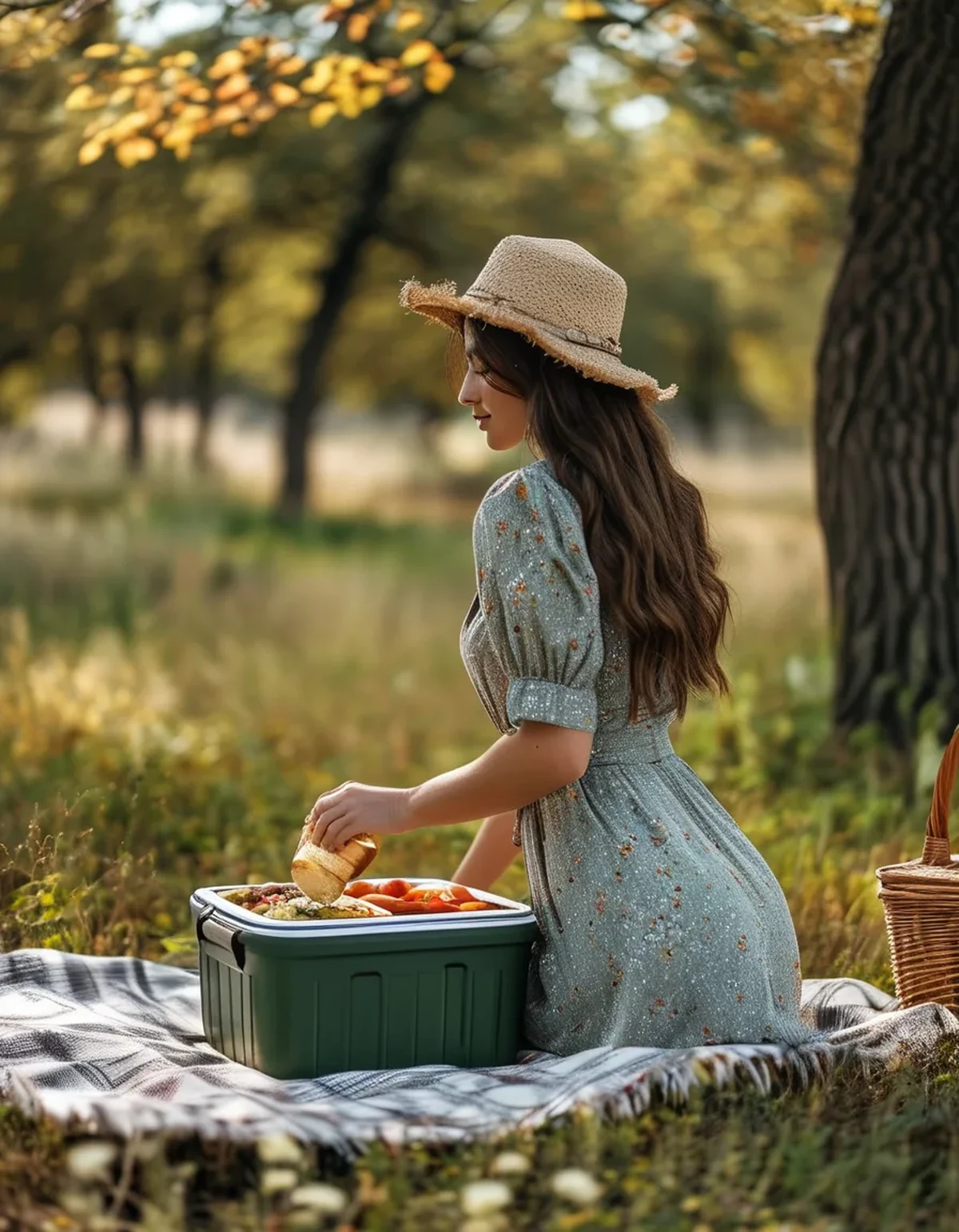
The cool box is doing its job. It is the lid that is the problem.
And there are a few other details that change the picture more than most people realise.
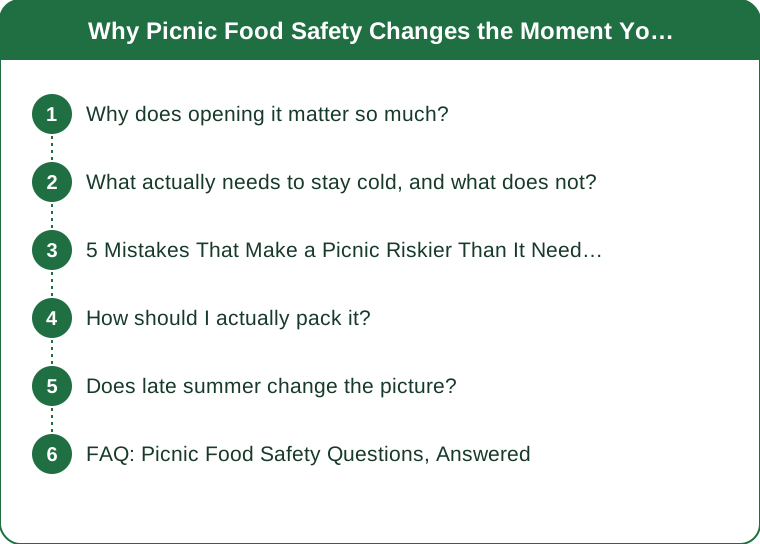
Why does opening it matter so much?
Because of how cold is stored in a cool box, and it is not where people think.
A cool box does not generate cold — it slows the transfer of heat into the contents. The cold is held in two places: the chilled food itself, and the cold air surrounding it.
Cold air is denser than warm air. When you open the lid, the cold air does not stay politely in place — it flows out over the edge, and warm air replaces it immediately. A single opening can exchange a substantial proportion of the internal air.
What happens next is the part people miss: the food then has to re-chill that new warm air, using its own cold. Every opening costs a little of the food’s remaining coldness, and the losses accumulate.
So the pattern that ruins a cool box is not one long opening. It is twenty short ones, which is exactly what happens when the drinks are in the same box as the food.
Three things follow directly:
Keep drinks separate. Drinks are what gets opened constantly. A separate bag or box for drinks protects the food box entirely, and it is the single highest-value change available.
Pack it full. Empty space is air, and air holds far less cold than solid contents. Fill gaps with extra ice packs, or with towels if you have nothing else.
Open it once, decisively. Take everything out at once and close it, rather than reaching in repeatedly.
How long does a well-packed cool box actually hold?
With good ice packs, packed full, kept in shade and rarely opened, several hours comfortably. Opened frequently in direct sun, considerably less than most people assume.
What actually needs to stay cold, and what does not?
Worth separating, because trying to keep everything cold is what causes the constant opening.
Genuinely needs to stay cold:
- Cooked meats, poultry and fish, including sandwiches containing them.
- Dairy — soft cheese, yoghurt, cream, milk. Hard cheese is more forgiving.
- Eggs and anything containing them, particularly mayonnaise-based salads and quiches.
- Prepared salads and dips with dairy or egg bases.
- Cut fruit and prepared vegetables, which have had their protective surface breached.
- Anything containing rice that has been cooked and cooled, which carries a specific risk worth taking seriously.
Does not need refrigeration:
- Whole uncut fruit, bread, crisps and crackers, biscuits.
- Hard cheese for a few hours, though it will sweat.
- Sealed jars and condiments not yet opened.
- Dried fruit, nuts, most baked goods.
The useful conclusion: pack the non-chilled items in a normal bag and put only the genuinely perishable things in the cool box. The box gets smaller, packs tighter, gets opened less, and works better.
And on the four-hour guidance: general food safety advice commonly allows chilled food to be out of refrigeration for up to four hours, after which it should be thrown away rather than returned to the fridge. That clock starts when the food leaves proper refrigeration, not when you arrive at the park. A journey counts.
5 Mistakes That Make a Picnic Riskier Than It Needs to Be
Putting the cool box in the boot. A car boot in late summer sun can reach temperatures far above the outside air, and the cool box spends the whole journey fighting it. Put it in the footwell of the air-conditioned cabin instead, and cover it if it is in sun through a window.
Bringing food back and putting it in the fridge. The four-hour clock does not reset. Food that has been out for hours and re-chilled has spent that whole time accumulating bacterial growth, and cooling it down does not undo it. Take less and finish it, or accept that leftovers are discarded.
Ice packs on top only. Cold air sinks, so ice packs work best distributed through the box and particularly on top — but relying on a single pack anywhere is the mistake. Ice packs above and below the food gives far more even cooling than one on the bottom, which is the intuitive but less effective placement.
Leaving it in the sun with a light-coloured lid and assuming that is fine. Colour helps a little. Shade helps enormously. A cool box in direct sun is working several times harder than one under a tree, and moving it as the shade moves is worth doing.
Cross-contamination in the packing. Raw or marinated meat for a barbecue packed alongside ready-to-eat food is the classic error, and it is a bigger risk than temperature in many cases. Raw items sealed and at the bottom, ready-to-eat above, and separate tongs and boards once you arrive. Also bring hand sanitiser — handwashing is rarely available and it matters more than people think.
This is general information. Follow official food safety guidance and use your judgement — when in doubt, throw it out.

How should I actually pack it?
A method that works, from the night before.
The night before:
- Chill everything thoroughly in the fridge overnight. A cool box maintains temperature; it does not reduce it. Room-temperature food put into a cool box starts in the danger zone and stays there.
- Freeze your ice packs solid, and freeze a couple of drinks or water bottles to act as additional ice that becomes drinkable later.
On the day:
- Chill the box itself if it has been in a hot cupboard — an ice pack inside for twenty minutes before packing makes a real difference.
- Pack it full, with ice packs on the bottom and on top, and gaps filled.
- Heaviest and most perishable at the bottom, where it is coldest.
- Raw items sealed and separated from ready-to-eat food.
- Separate bag for drinks, which is the one that gets opened.
On arrival:
- Straight into shade, and moved as the shade moves.
- A towel or blanket over the box adds meaningful insulation for no cost.
- Open once, take out what is needed, and close it immediately.
- Serve in portions rather than putting everything out, so the rest stays cold.
And bring a bin bag. Not a safety point, but the difference between a good picnic and a bad end to one.
Are cool bags as good as hard cool boxes?
No, but they are much better than nothing and considerably more portable. A soft bag with good ice packs, packed full and rarely opened, handles a few hours fine. For a full day in heat, a hard box wins clearly.
Does late summer change the picture?
Yes, in two directions at once, which makes it a slightly deceptive time of year.
The air is cooler, which helps. Late August evenings are noticeably cooler than July’s, so the ambient temperature working against your cool box is lower, particularly after mid-afternoon.
But the sun is still strong and the ground is still warm, and daytime temperatures can be as high as midsummer. The risk has not gone away, and the perception that it is now safe because it feels cooler is the actual hazard at this point in the season.
A few other late-summer specifics:
Wasps become considerably more aggressive. Late in the season their nests stop producing brood, the workers lose their usual food source, and they turn to sugar and protein — which is exactly what a picnic is. Keep food covered and drinks in bottles with lids, since a wasp in an open can is a genuine hazard.
Dew arrives earlier and the ground gets damp sooner, which affects where you put things down as much as what you eat.
Days shorten quickly, and it gets harder to see what you are eating and to pack up properly. Worth starting earlier than you would have in July.
And there is more insect and mould activity around fruit at this time of year, so cut fruit deteriorates faster than the temperature alone suggests.
The practical version for the next few weeks: treat a warm September afternoon exactly as you would treat July, keep everything covered, and start earlier so you are packing up in daylight.
Is it safer once the weather turns properly cold?
Cooler ambient temperature does help, and the four-hour guidance is about time out of refrigeration rather than about the weather. The rules do not change with the season.
FAQ: Picnic Food Safety Questions, Answered
Can I take leftovers home and eat them later?
General guidance is that chilled food out of refrigeration for up to four hours should then be discarded rather than re-chilled. Plan portions so there are none.
How do I keep sandwiches from going soggy and staying safe at once?
Assemble wet ingredients separately and add them at the picnic. It solves both problems, and it keeps the perishable elements in the cold longer.
Is cooked rice really a specific risk?
Cooked rice can support the growth of a bacterium that produces a toxin not destroyed by reheating, so cooling it quickly and keeping it properly cold matters more than for most foods.
Do I need to worry in cool weather?
The four-hour guidance concerns time out of refrigeration. Cooler weather helps, and it does not remove the need for a cool box.
What is the best single upgrade?
A separate bag for drinks. It stops the food box being opened twenty times, which is what actually loses the cold.
TL;DR:
- Cool boxes lose most of their performance to repeated opening, because dense cold air pours out each time.
- Keep drinks in a separate bag. It is the single highest-value change.
- Pack it full and pre-chill everything overnight — a cool box maintains temperature, it does not create it.
- Ice packs above and below, heaviest and most perishable at the bottom.
- General guidance allows chilled food up to four hours out of refrigeration, then discard — the journey counts, and re-chilling does not reset it.
- Boot of the car is the worst place; footwell of the cabin is far better.
- Late summer feels safer than it is, and wasps get aggressive as the season ends.
This is general information — follow official food safety guidance and when in doubt, throw it out.
The box was fine. It was the twelve times someone went looking for the lemonade.
Keep Reading
This article is for general informational purposes only and is not medical advice. Always consult a qualified health professional for guidance specific to you.