Why Ground Moisture Ruins an Autumn Picnic Before the Air Does
Quick Answer: Autumn ground stays wet all day because shorter days and lower sun angles mean dew and overnight moisture never fully evaporate, and cold damp ground pulls heat from you by conduction far faster than cool air does. A standard picnic blanket does nothing about either. The fix is a waterproof barrier under the blanket, an insulating layer between you and the ground, and choosing a spot that has had direct sun on it for at least a couple of hours. Air temperature is almost irrelevant to how the afternoon feels.
The forecast said 18 degrees and sunny, which in July would have been a perfect picnic. You get there, lay out the blanket, sit down, and within half an hour you are cold in a way the temperature does not explain.
This blog has covered why autumn picnics need a different packing list and why spots near water run colder than forecast. The ground is the specific mechanism, and it is the one people plan for least.

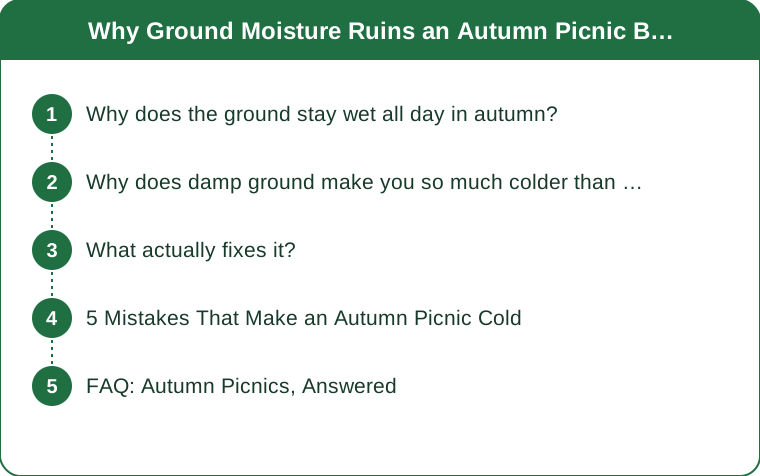
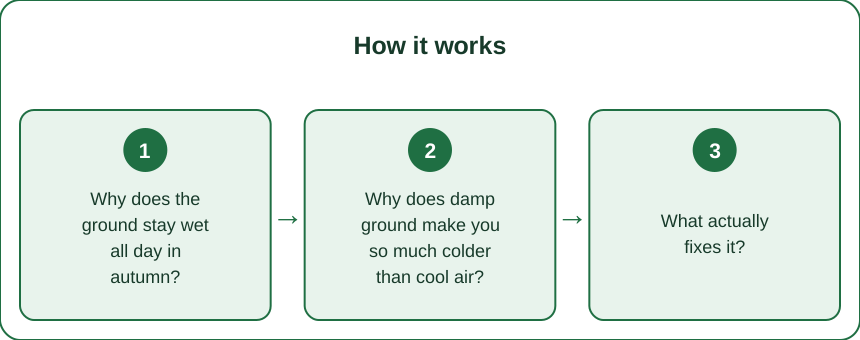
Why does the ground stay wet all day in autumn?
Because the drying half of the daily cycle gets much shorter and much weaker.
Dew forms overnight when surfaces cool below the dew point. Clear autumn nights radiate heat away efficiently, so grass drops well below air temperature and collects moisture. Autumn nights are longer, clearer, and colder, so more dew forms than in summer.
And the drying window is dramatically reduced. Evaporation depends on sunlight, air temperature, and how much moisture the air can still absorb. In autumn the sun is lower, the day is shorter, and cool air holds far less water vapour, so the same amount of moisture takes far longer to leave.
Shade never dries at all. In summer, a shaded patch of grass still gets warm enough to dry out. In autumn, ground that does not receive direct sun stays wet from one night to the next, accumulating rather than drying. This is why the grass under a tree in October is genuinely soaking at 2pm.
Leaf fall makes it considerably worse. A layer of fallen leaves holds moisture against the ground and blocks what little sun and airflow would otherwise dry it. The picturesque leaf-covered spot is the wettest available option.
The soil underneath is also cold and saturated. Ground temperature lags air temperature by weeks. In autumn the soil is still cooling from summer and is being recharged with water, so even ground that feels dry on the surface is cold and damp a centimetre down.
Why does damp ground make you so much colder than cool air?
Because sitting on it puts you in direct contact with a large cold mass, and water makes that contact far more efficient.
Conduction moves heat much faster than convection. Cool air surrounding you removes heat relatively slowly. Direct contact with a cold surface removes it far faster, because heat flows directly into the material you are touching.
Water conducts heat many times better than air. Damp fabric between you and the ground is not a barrier, it is a bridge. This is the same principle behind why wet clothing in cold conditions is dangerous and dry clothing is not.
The contact area is large and it is not moving. Sitting places a substantial portion of your body in continuous contact with the ground for an extended period, with no opportunity for the surface to warm up because the ground is effectively infinite in heat capacity compared to you.
A cotton blanket wicks moisture upward. A standard woven picnic blanket absorbs ground moisture and holds it against you. Within twenty minutes the blanket is damp, and you are now sitting on a wet layer rather than a dry one.
Which explains the specific experience. You feel fine standing and cold within minutes of sitting, and the coldness is concentrated where you are in contact. Adding a jumper does very little because the heat is not leaving through the air.
And it is not only comfort. Sitting on cold damp ground for a long period in cool conditions is a genuine route to getting properly chilled, particularly for children who have less body mass and often sit still for longer than they should.

What actually fixes it?
A three-layer approach that costs almost nothing and changes the afternoon completely.
Layer 1: a waterproof barrier. A tarp, a groundsheet, a plastic-backed picnic blanket, or in a pinch a few large bin bags. This stops moisture moving upward at all and is the single most important item.
Layer 2: insulation. This is the layer everyone skips. A foam camping mat, a folded fleece blanket, a couple of cushions, or even a folded towel. The point is to put something with trapped air between you and the cold mass below. Foam is far better than fabric for the same thickness.
Layer 3: the nice blanket. Whatever you actually wanted to sit on goes on top, staying dry because everything below is doing its job.
Choosing the spot matters as much as the kit:
- Find ground that has had direct sun for at least two hours, which in autumn means a south-facing open area rather than anywhere sheltered.
- Avoid low ground and dips, where cold air pools and water collects.
- Avoid under trees, which are the wettest ground available and also drip long after any rain.
- A slight slope drains better than flat ground, which is a small effect and a real one.
- A bench or a picnic table beats the ground entirely in autumn, which sounds like giving up and is simply the correct answer once the ground is wet.
Bring something to sit on individually. Small foam sit pads, the kind hikers use, weigh nothing and are the single best value item for autumn outdoor sitting. One per person costs very little and removes the problem entirely.
And time it for the middle of the day. The window from late morning to mid afternoon is when the ground is at its driest and the sun is at its highest. An autumn picnic at 4pm is a fundamentally different and colder proposition than the same picnic at 1pm.
5 Mistakes That Make an Autumn Picnic Cold
1. Bringing only the same blanket you used in summer. A single woven layer is fine on dry warm ground and useless on cold damp ground. It absorbs moisture and conducts heat, which is the opposite of both jobs.
2. Choosing the prettiest spot. The best light in autumn is under trees among fallen leaves, which is also the wettest and coldest ground available. The correct spot is the boring open sunny one.
3. Dressing for the air and not for the ground. Extra upper-body layers do very little when heat is leaving through conduction beneath you. An insulating layer under you is worth more than an extra jumper on you.
4. Sitting still for two hours. Movement generates heat, and the classic autumn picnic involves sitting almost motionless while eating and talking. Getting up every twenty minutes changes how the whole thing feels, and it is why the children are usually fine while the adults are freezing.
5. Starting too late. The ground is at its driest and the sun at its strongest between roughly late morning and mid afternoon. After 3pm in autumn, temperature drops fast, the sun angle collapses, and dew begins forming again well before dark.
And one bonus that has nothing to do with temperature: food cools far faster on cold ground too. A container placed directly on autumn grass loses heat quickly, so anything you wanted to stay warm should sit on the insulating layer with you, not on the ground beside you.
FAQ: Autumn Picnics, Answered
Why am I cold at a picnic when the temperature is fine?
Because you are losing heat by conduction into cold damp ground rather than by convection into the air. Direct contact with a large cold mass removes heat far faster than cool air does, and damp fabric accelerates it.
What should I put under a picnic blanket in autumn?
A waterproof barrier first, such as a tarp or groundsheet, then an insulating layer such as a foam mat or folded fleece, then your blanket. The insulating middle layer is the one most people skip and the one that matters most.
What time is best for an autumn picnic?
Late morning to mid afternoon. The ground is at its driest, the sun is at its highest angle, and you finish before the temperature drop and the evening dew both arrive, which happens much earlier than people expect.
TL;DR:
- Autumn ground stays wet all day because nights are longer and the drying window is short and weak.
- Damp cold ground removes your heat by conduction far faster than cool air does, which is why a jumper does not help.
- Use three layers: waterproof barrier, insulation, then your blanket. The insulating middle layer is the one people skip.
- Pick open ground that has had two hours of direct sun, avoid trees and leaves, and finish before mid afternoon.
Small foam sit pads cost almost nothing and solve most of this on their own. Buy one per person and keep them in the car.
Keep Reading
This article is for general informational purposes only and is not medical advice. Always consult a qualified health professional for guidance specific to you.