Why Yellowjackets Get Aggressive at Late-Summer Picnics and Not in June
Quick Answer: Early in the season yellowjacket colonies feed protein to developing larvae and are focused on hunting insects. By late summer the queen stops laying, the larvae are gone, and the adult workers switch to seeking sugar for themselves while their food supply collapses. That combination of dietary shift and scarcity is why they suddenly appear at your table in August and September.
You picnicked in the same park in June and saw nothing. Now there are six of them circling the lemonade. Nothing about the park changed. The wasps changed jobs.

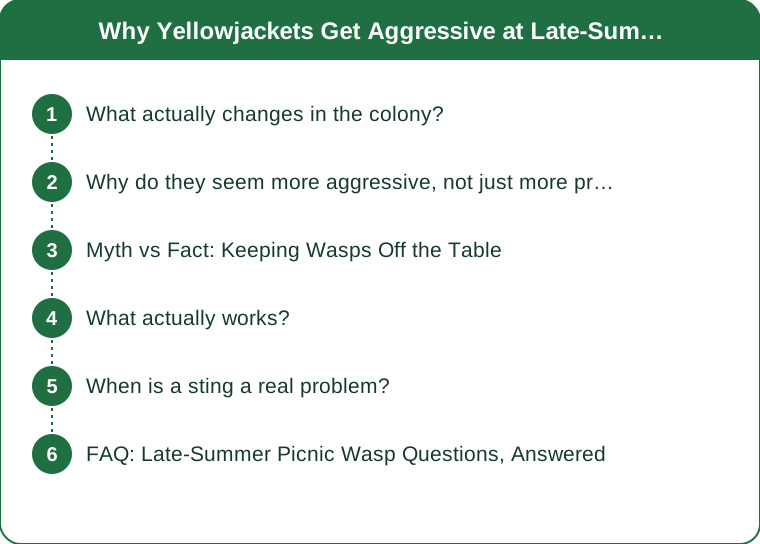
What actually changes in the colony?
A yellowjacket colony runs an annual cycle, and late summer is the point where its internal economy breaks down.
Through spring and early summer, workers hunt other insects and bring protein back to feed larvae. In exchange, larvae secrete a sugary substance that the adult workers feed on. It is a closed loop, and while it is running, the workers have both a purpose and a food source, and they are not interested in your sandwich.
In late summer the queen stops producing new workers and the colony shifts to producing reproductives. The larvae mature and stop being fed. The sugary secretion that sustained the adult workers disappears.
So now you have a large population of adult workers, often at peak colony size, with no larvae to feed, no internal sugar supply, and a diminishing supply of natural nectar and fallen fruit as the season turns.
They are hungry, numerous, and out of a job. That is the entire mechanism, and it explains both the timing and the change in behavior, since a foraging insect that is competing for scarce resources is far more persistent and more defensive than one that is not.
Why do they seem more aggressive, not just more present?
Two reasons, one behavioral and one about how we respond to them.
Behaviorally, a scarce-resource forager defends a found food source. In June, a wasp that finds your food will often take a sample and leave. In September, that same wasp may recruit nestmates and treat the site as a resource worth returning to and defending. Persistence reads as aggression.
The second reason is us. When one wasp is circling, people wave. Rapid movement near a wasp is interpreted as a threat, and defensive stinging is far more likely in response to swatting than to sitting still.
Yellowjackets can sting repeatedly, unlike honeybees, which is why an encounter that escalates goes badly faster.
It is also worth knowing that crushing one is the worst possible response. Alarm pheromone released by a crushed or threatened yellowjacket recruits others, and it can escalate a single visitor into several within a minute. Never swat one at the table.
Myth vs Fact: Keeping Wasps Off the Table
Myth: They are after your meat, like flies. Fact: In late summer they want sugar first. Soda, juice, fruit, and anything sweet are the primary attractants. Protein interest drops off precisely as sugar interest rises, which is the reverse of early season.
Myth: A brown paper bag that looks like a nest keeps them away. Fact: Widely repeated and poorly supported. Yellowjackets do not reliably avoid areas near what looks like another nest, and testing has not backed this up.
Myth: Citronella candles work. Fact: Citronella has modest effects on some mosquitoes and essentially none on yellowjackets. It is a comfortable ritual, not a control measure.
Myth: Dark colors attract them. Fact: Bright floral colors and floral scents are more attractive, since they mimic nectar sources. Perfume and scented sunscreen matter more than your shirt.
The practical one people miss: the open drink can is the single biggest hazard, not because it attracts more wasps but because a wasp inside a can you cannot see through leads to stings in the mouth and throat, which is the genuinely dangerous version of this problem. Use a lid and a straw, or a clear cup, every time.

What actually works?
Five measures, in order of effectiveness.
1. Keep everything covered until the moment you eat, and covered again immediately after. Mesh food covers cost almost nothing and are the single highest-return item. Exposure time is the variable that determines whether one scout finds you.
2. Set a decoy station away from the table. A small plate of something sweet placed 20 to 30 feet downwind gives foragers a closer, easier resource. This genuinely works and is what many outdoor venues do.
3. Manage the trash. An open bin within ten meters undermines everything else. If you are packing out, seal waste in a bag and put it away from the eating area.
4. Sit still and let them go. A wasp investigating your plate will usually leave within seconds if nothing threatens it. Gentle, slow movement of the hand away is fine. Fast movement is not.
5. Avoid strong floral scents. Perfume, scented sunscreen, and hair products increase attention, and this is easy to control before you leave home.
What does not work reliably: ultrasonic devices, most sprays applied to the area, and the paper bag. Spending on a mesh cover and a decoy plate beats all of them.
When is a sting a real problem?
Most stings are painful and unremarkable. A few situations are not, and it is worth knowing the difference before you need it.
Normal reaction: pain, redness, and local swelling that peaks within a few hours and resolves over a day or two. Cold compress, an antihistamine if you want, and it passes. A large local reaction with swelling extending well beyond the sting site can look alarming and is still usually not dangerous, though it warrants a call to a clinician.
Seek emergency care immediately for: difficulty breathing, swelling of the face, lips, tongue, or throat, hives spreading beyond the sting area, dizziness or fainting, or a rapid pulse. These indicate anaphylaxis and it can develop within minutes.
Also seek care for stings inside the mouth or throat regardless of allergy history, because swelling in the airway is dangerous on its own. This is the reason the drink can rule matters.
If anyone in your group carries an epinephrine auto-injector, know where it is before the picnic rather than after. Multiple stings, particularly more than about ten in a child, also warrant medical evaluation.
This is general information, not medical advice.
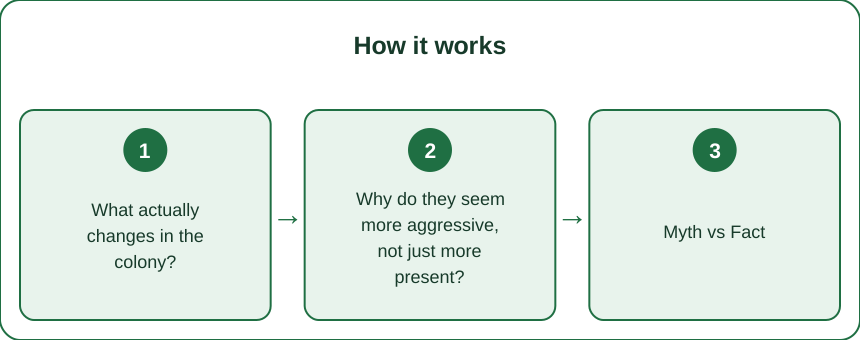
FAQ: Late-Summer Picnic Wasp Questions, Answered
When does it end?
The first sustained hard frost ends the colony. Workers and the old queen die, and only newly mated queens overwinter. In most of the US that means the problem peaks from mid-August through September and disappears fairly abruptly.
Are they worse near water or in open fields?
Neither particularly, but they are worse near food sources and nests. Established picnic areas with permanent bins have higher populations than a random field, which is a real argument for the less convenient spot.
What about honeybees, are they doing this too?
No. Honeybees are not interested in your food and are foraging nectar and pollen. If an insect is investigating your soda or your sandwich, it is almost certainly a yellowjacket or a paper wasp, not a bee.
TL;DR:
- Colonies stop raising larvae in late summer, so workers lose their sugar supply and start foraging yours
- Persistence rises because they are defending a scarce resource, and swatting releases alarm pheromone
- Cover food except while eating, set a decoy plate 20-30 feet away, and never drink from an opaque can
- Airway stings and any breathing or facial swelling are emergencies
Buy a mesh cover, keep the drinks in clear cups, and stop waving. That is roughly the whole strategy for the next six weeks.
Keep Reading
This article is for general informational purposes only and is not medical advice. Always consult a qualified health professional for guidance specific to you.